

You finally get rid of the pimple.
Then you look in the mirror and realise… the spot it left behind isn’t going anywhere.
So you do what many of us have done at some point.
You buy a brightening serum.
Then an exfoliant.
Then maybe another treatment because someone online said it works fast.
You start layering products, scrubbing a little harder and hoping that if you attack the dark spot aggressively enough, it will disappear.
But here’s the uncomfortable truth:
Your dark spot doesn’t need more aggression. Your skin may need less.
When you’re dealing with post-acne dark marks, especially on melanin-rich skin, the goal isn’t simply to fade pigmentation. It’s to do it without repeatedly irritating the skin and creating more inflammation in the process.

Why are acne dark spots so stubborn?
The dark mark left behind after acne is often post-inflammatory hyperpigmentation (PIH).
When acne causes inflammation, the skin can respond by producing and depositing more melanin around the affected area. Once the pimple heals, that pigment can remain behind as a flat brown or darker mark. PIH is particularly common and often more persistent in darker skin tones.
So you can have:
No more pimple.
No swelling.
No active inflammation.
…but still have a visible reminder of the breakout.
And because the mark can take much longer to fade than the original acne, it’s easy to become impatient.
That’s when over-treatment often begins.
The “stronger must be better” skincare trap
When a dark spot refuses to fade, it’s tempting to think:
Maybe I just need something stronger.
So you exfoliate more often.
You combine multiple acids.
You introduce several brightening products at once.
You scrub.
You peel.
You keep changing your routine because the previous product didn’t produce overnight results.
But skincare doesn’t work like cleaning a stubborn stain from a shirt.
Your skin is living tissue.
Irritating it repeatedly can make the situation worse. The American Academy of Dermatology notes that irritated skin can contribute to dark spots, and recommends gentler products when managing hyperpigmentation in darker skin tones.
And when you’re already prone to pigmentation after inflammation, that matters.
You don’t want to spend weeks trying to fade one dark spot… only to create another one because your routine became too aggressive.
So, how do you fade dark spots without irritating your skin?
Think targeted, consistent and gentle.
Not complicated.
Not aggressive.
Not a 12-step routine that requires a spreadsheet.
1. Stop trying to fix everything at once
Your skin doesn’t need five new products because you noticed one dark mark.
Introduce products thoughtfully and give your routine time.
The AAD also recommends sticking with acne treatments rather than constantly switching between them, because repeatedly trying new treatments can irritate the skin and trigger breakouts.
Consistency might not feel exciting…
but your skin doesn’t need excitement.
It needs consistency.
2. Treat the acne as well as the dark spot
Here’s something that often gets overlooked:
You can’t effectively manage the aftermath while ignoring the cause.
If you’re constantly breaking out, you’re constantly creating new opportunities for inflammation and new dark marks.
That’s why a good acne routine should have two goals:
Manage existing breakouts.
Reduce the chance of repeated breakouts.
3. Protect your skin from the sun
If you’re working on dark spots, sunscreen shouldn’t be an afterthought.
UV exposure can make existing pigmentation darker, and sun protection is an important part of managing hyperpigmentation. Dermatologists commonly recommend broad-spectrum SPF 30 or higher, with appropriate reapplication when outdoors.
Think about it this way:
You’re trying to fade the mark.
You don’t want your daily environment continually encouraging more pigmentation.
So your routine shouldn’t just ask:
“What can I use to fade this?”
It should also ask:
“What can I do to stop it from getting darker?”
4. Treat the dark spot… not your entire face
This is where targeted skincare can make a lot of sense.
If you’ve got one or two stubborn post-acne marks, you may not need to cover your entire face in another active product just because those particular spots are bothering you.
You can take a more targeted approach.
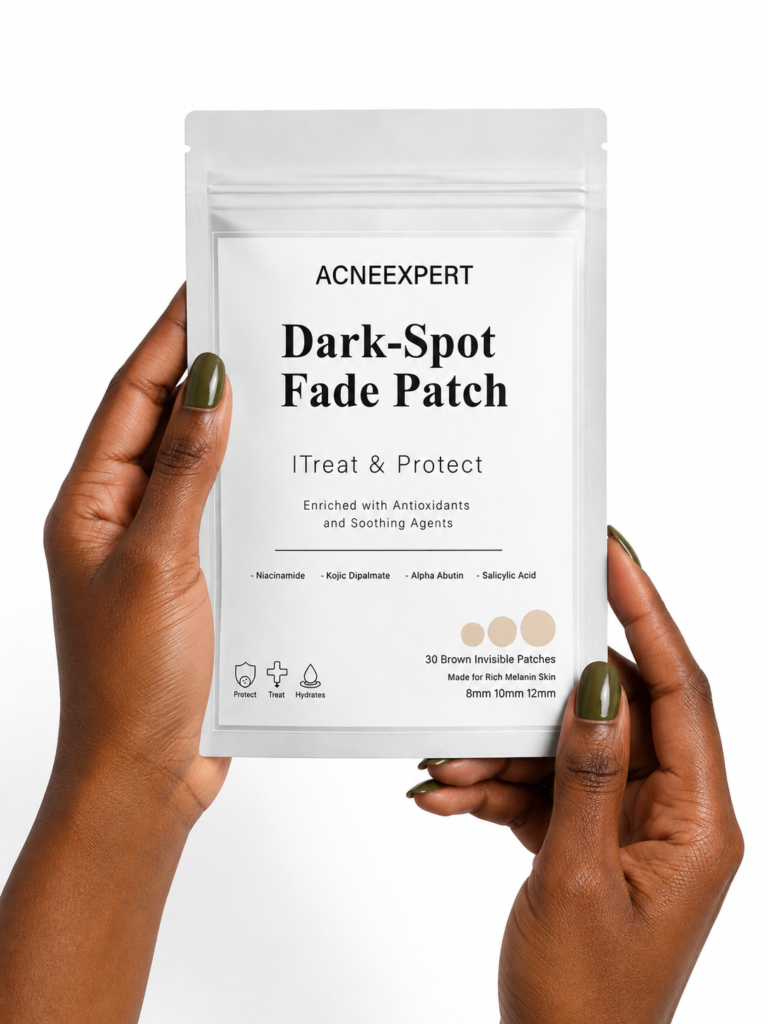
That’s the idea behind the Acneexpertskin Dark Spot Fade Patch.
Rather than treating your entire face, the patch is designed to provide targeted care to the appearance of dark spots and hyperpigmentation.
Its formula contains:
- Niacinamide
- Kojic Dipalmitate
- Alpha Arbutin
- Salicylic Acid
So instead of thinking:
“I need another product for my whole face.”
You can think:
“I know exactly where I want to focus my care.”
That’s a very different approach to skincare.
Targeted doesn’t mean overnight
We need to say this because skincare marketing has made all of us impatient.
A dark spot that has been sitting on your skin for weeks or months isn’t necessarily going to disappear after one night.
How quickly pigmentation fades varies depending on factors including the depth of the pigment, the cause of the pigmentation, your skin and whether the area continues to experience inflammation or irritation.
Some dark spots can take months to fade.
So don’t judge a product after two days.
And don’t abandon your routine every time you see another skincare product promising “instant results.”
Your skin isn’t behind schedule.
It’s healing.
What if a product burns or stings?
This is one of the biggest things to pay attention to.
There’s a difference between using an active ingredient as directed and repeatedly irritating your skin.
If a product causes significant burning, stinging, redness or irritation, don’t assume that means it’s “working.”
The AAD specifically advises choosing gentle skincare products and stopping products that burn or sting, as irritation can contribute to dark spots.
Pain isn’t proof of progress.
That’s a skincare myth we can happily leave behind.
Your dark-spot routine doesn’t have to be complicated
A practical routine might look something like:
Step 1 — Cleanse
Use a cleanser suited to your skin’s needs and avoid unnecessarily harsh cleansing.
Step 2 — Treat
Use targeted care for the specific dark marks you’re trying to address.
This is where the Dark Spot Fade Patch can fit into your routine.
Step 3 — Moisturise
Support your skin with appropriate hydration rather than constantly stripping it.
Step 4 — Protect
Use sunscreen during the day, particularly when you’re outdoors.
Step 5 — Repeat
This is the part nobody wants to hear.
Keep going.
Because a simple routine you can actually maintain will usually serve you better than an elaborate routine you abandon after a week.
The goal isn’t lighter skin. It’s healthier-looking, more even skin.
There’s an important distinction here.
When we talk about fading dark spots, we’re not talking about changing your natural complexion.
We’re talking about helping areas of uneven pigmentation become less noticeable so your skin can look more even and balanced.
Your melanin isn’t the problem.
The dark mark is simply a response your skin has produced after inflammation.
And that means skincare should be about working with your skin… not fighting against it.
Don’t let impatience turn one dark spot into three
The next time you notice a stubborn mark after a breakout, resist the urge to attack it with everything in your bathroom.
Instead:
Treat your acne.
Don’t pick.
Avoid unnecessary irritation.
Use targeted care.
Protect your skin from the sun.
And give your routine time.
A note from Acneexpertskin
If your pigmentation is severe, keeps worsening, is changing unexpectedly, or you’re unsure whether you’re dealing with post-acne pigmentation or actual scarring, it’s worth speaking with a dermatologist or qualified healthcare professional. Persistent or severe acne may also need professional treatment.
Your skin deserves a plan… not a panic reaction.
And if the pimple is gone but the mark stayed behind, targeted care can be the next step.


