

If Acne Awareness Month still feels necessary in 2026, it’s not because acne hasn’t been studied enough.
It’s because people are still overwhelmed with the wrong information.
The real crisis today is not a lack of skincare products. It is the overabundance of conflicting advice, routines that contradict each other, influencers that simplify complex skin biology, and viral “cures” that rarely survive beyond a trend cycle.
Acne has become one of the most over-explained skin conditions on the internet, yet one of the most misunderstood in real life.
And that contradiction is exactly why so many people feel stuck.
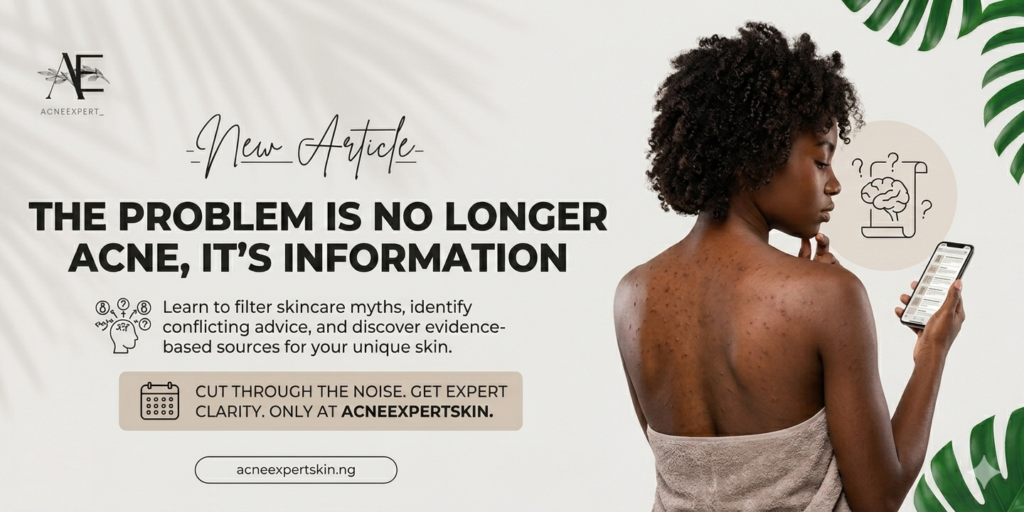
In 2026, a typical acne journey looks like this: someone starts with a breakout, searches online, gets hit with 20 different solutions, tries three at once, gets worse results, then assumes their skin is “complicated” or “resistant.”
But the truth is simpler and more uncomfortable.
Most acne isn’t failing to respond to treatment, it’s reacting to confusion.
Acne Awareness Month, at its core, is supposed to slow that cycle down. Not by adding more information, but by filtering out noise.
Because when you remove the noise, acne stops looking like a mystery and starts behaving like a pattern.
And patterns can be understood.
The Information Overload Problem in Skincare Culture
The skincare space in 2026 is louder than ever.
Every week, there is a new “breakthrough” ingredient, a new viral routine, a new before-and-after that promises transformation in days. While some of this content is helpful, a large portion of it creates a dangerous illusion: that acne is simple, fast, and universally treatable with one formula.
But acne doesn’t work like that.
It is influenced by multiple layers:
- Skin biology (oil production, cell turnover, bacteria)
- Hormonal fluctuations
- Lifestyle patterns (sleep, stress, diet variability)
- Product interaction and routine consistency
When people receive simplified advice that ignores this complexity, they don’t just get confused, they often worsen their condition by over-correcting.
Instead of observing their skin, they start experimenting on it.
And experimentation without understanding usually leads to irritation, not improvement.
Why Most Acne Routines Fail in 2026
One of the biggest misunderstandings today is that failure means “the skin is stubborn.”
In reality, most routine failure comes from instability, not resistance.
Here’s the pattern:
- New breakout → new product added
- No immediate result → product switched
- More breakout → stronger product introduced
- Skin becomes irritated → routine reset again
This cycle prevents the skin from ever reaching a stable state.
Acne doesn’t improve under constant change. It improves under consistent direction.
And that is exactly what most online advice fails to emphasize, consistency over intensity.
Acne Awareness Month Is About Resetting the Narrative
The original purpose of Acne Awareness Month was never just education. It was alignment.
Alignment between what people think acne is, and what it actually is.
Because once expectations are corrected, treatment becomes more effective.
Acne Awareness Month 2026 should not be about adding more tips to the internet.
It should be about reducing unnecessary ones.
Not every breakout needs a new product.
Not every reaction is a purge.
Not every delay means failure.
Sometimes, the skin is simply overwhelmed by conflicting signals.
And clarity is often the first real step toward improvement.
The Shift: From Searching to Understanding
There is a quiet but important shift happening in modern skincare education.
People are beginning to realize that:
- More information is not always better
- More products are not always progress
- Faster reactions are not always improvement
Instead of constantly searching for “what to use next,” the focus is slowly moving toward:
- What is my skin responding to?
- What is causing repeated irritation?
- What can I remove instead of add?
This is the direction Acne Awareness Month is trying to push forward.
Not urgency — understanding.
Not overload — clarity.
Frequently Asked Questions (FAQ)
1. Why is Acne Awareness Month still relevant in 2026?
Because despite increased access to skincare knowledge, misinformation has also increased. Many people still rely on conflicting advice from social media, leading to confusion, over-treatment, and poor skin outcomes.
2. Is acne caused by using the wrong skincare products only?
No. While skincare products can influence acne, it is not the only factor. Acne is affected by hormones, genetics, lifestyle habits, stress levels, and how consistently a routine is followed. Products alone cannot fully determine skin behavior.
3. Why do so many acne routines fail even when people follow them strictly?
Most failures come from inconsistency in routine structure, not lack of effort. Constantly changing products or layering too many active ingredients prevents the skin from stabilizing long enough to respond properly.
4. Can too much skincare make acne worse?
Yes. Overuse of active ingredients or harsh products can damage the skin barrier, leading to increased irritation, sensitivity, and breakouts. In many cases, simplifying the routine improves results more than adding new treatments.
5. How long should someone stick to an acne routine before changing it?
In general, skin needs consistent exposure to a routine for several weeks before meaningful changes are visible. Frequent switching prevents the skin from adjusting and delays improvement.
6. What is the biggest mistake people make during acne treatment?
The biggest mistake is reacting too quickly to short-term changes. Acne treatment requires patience and consistency, but many people change routines before the skin has time to respond.
7. Is acne always caused by internal health issues?
Not always. Acne can be influenced by internal factors like hormones, but it can also be triggered or worsened by external factors such as product buildup, irritation, or environmental exposure.
8. What should people focus on instead of searching for new acne solutions all the time?
They should focus on understanding their skin patterns, what triggers breakouts, what calms inflammation, and what routine structure keeps their skin stable over time.


